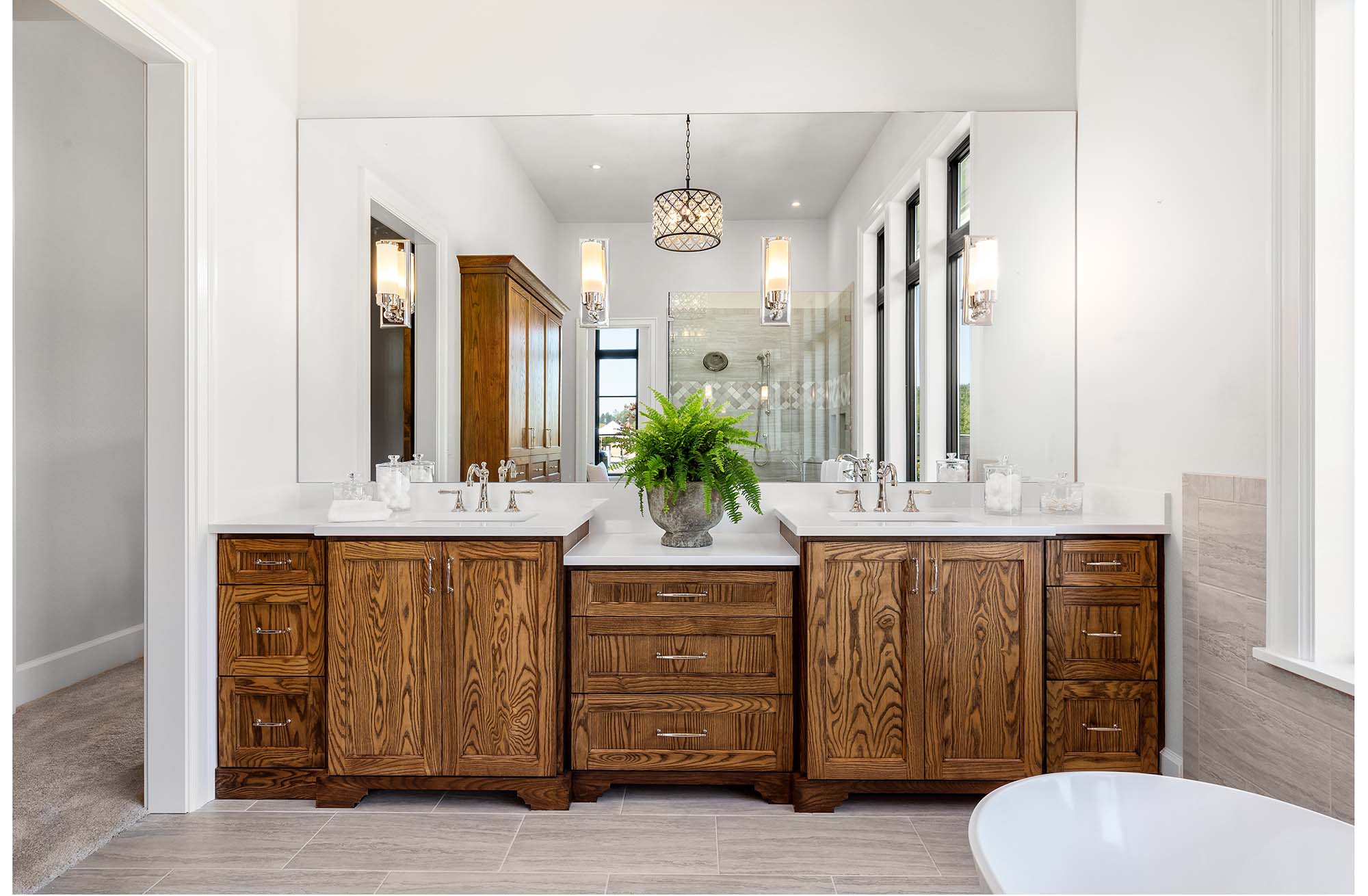
Most people assume they know what their cabinets are made of until someone asks them to prove it. Between marketing terms, mixed construction, and doors that look nothing like the box behind them, it is genuinely hard to tell what you are looking at without knowing where to check. None of this requires a contractor or a moisture meter, just a few minutes and an open drawer.
Check the Drawer Box Before Anything Else
The drawer box, not the front, tells you the most about actual cabinet construction, since manufacturers save costs on hidden parts before they ever touch a visible door front. Pull a drawer all the way out and look at the sides and bottom. Solid wood or plywood drawer boxes show a visible grain pattern and a joined corner, usually a dovetail, where the pieces interlock. Particleboard drawer boxes show a speckled, compressed texture with no visible grain, and the corners are almost always stapled or glued flat rather than joined.
This single check tells you more than looking at the cabinet doors ever will, because it is common and completely legitimate for a cabinet line to use solid wood doors on a particleboard or MDF box. That is a normal cost saving decision in mid range cabinetry, not a red flag on its own. The drawer box test just tells you which situation you are actually dealing with.
The Edge Test on an Interior Panel
Find an interior panel that is not painted or covered in laminate, usually inside a cabinet near the hinge or along a shelf edge. Real wood and plywood show a continuous edge with visible grain running through the entire thickness of the material. Particleboard shows a distinctly different edge, a compressed, uniform texture that looks almost like sawdust pressed into a block, because that is essentially what it is.
MDF sits in between visually, since it has a smooth, dense edge with no visible wood grain but also no obvious particle texture. If the edge looks perfectly smooth and uniform with zero grain pattern anywhere, you are most likely looking at MDF rather than a natural wood product, even if the door front convinced you otherwise.
Weight Is a Genuinely Useful Clue
Solid wood is lighter than most people expect relative to its density, while particleboard is noticeably heavier for its size because of how densely the wood fibers are compressed with resin. If you can safely lift a cabinet door off its hinges, or simply push on a large door front and feel for how much it wants to swing versus resist, particleboard doors tend to feel heavier and more inert than solid wood ones of the same size.
This is not a perfectly scientific test, but combined with the drawer box and edge checks, it adds another data point that usually confirms what you already suspected. Weight alone should never be the only test you rely on, since MDF and particleboard can feel similar depending on thickness and core density.
Why This Distinction Actually Matters for Your Home
None of these materials are inherently bad, and each has a legitimate place depending on budget, moisture exposure, and how the cabinet gets used. Particleboard performs fine in low moisture areas with light daily use, while solid wood and plywood construction hold up better in areas with more humidity or heavier daily wear, like a kitchen sink base or a bathroom vanity near a shower.
Knowing what you actually have matters most when you are deciding whether to repair, reface, or fully replace cabinetry during a remodel. A particleboard box that has swollen from water exposure is rarely worth saving, while a solid wood or plywood box with the same damage often just needs the finish addressed rather than a full replacement.
If you want a straight answer about what your current cabinets are made of, or you are ready to talk through construction options for a remodel, Heartland Cabinetry & More can walk you through it in person. We serve homeowners throughout Bourbonnais, Kankakee, Manteno, Watseka, Bradley, and the surrounding areas and welcome you to see actual cabinet construction samples at Bourbonnais, IL. Explore our Cabinetry options or contact us to talk through what makes sense for your space.